
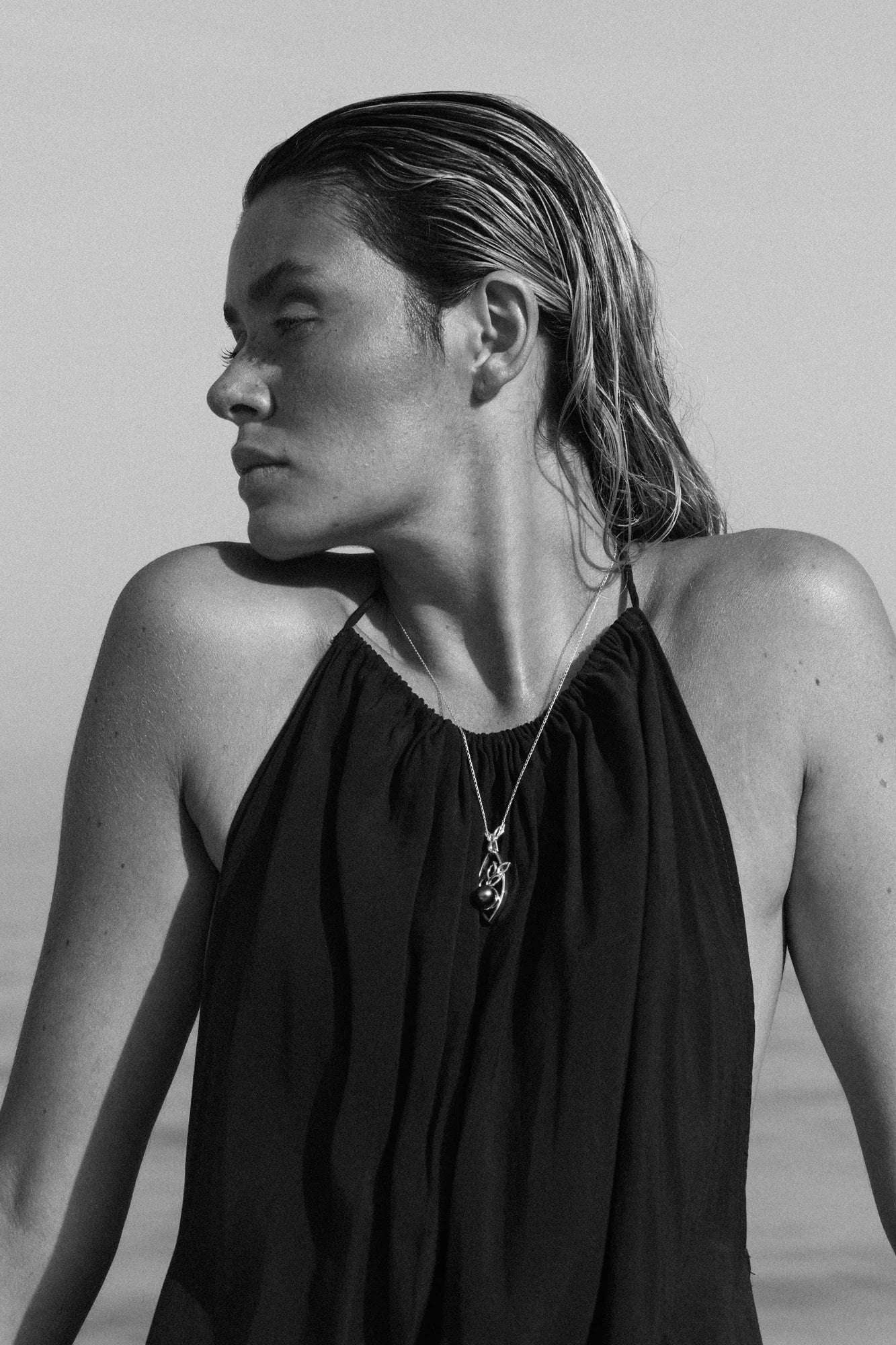
Deeply.
Leatherback
Art Collection
At Honu Handmade Jewellery, the sea turtle plays a fundamental role.
It lends its name to the brand, provides direction for the workshop and instils a sense of responsibility in the creative process. Honu means ‘sea turtle’ in Polynesian. This word evokes the ocean, the journey, longevity, memory and a return to one’s origins.
Of the seven known species of sea turtle, one stands out in particular: the leatherback turtle.

Lines of Leatherback
Its name alone offers several layers of meaning. It evokes the musical instrument, with its elongated shape and taut lines. It also evokes a struggle, that of an ancient, immense species, now on borrowed time, whose survival depends directly on human choices.
This page serves to lay the foundations for this symbol at Honu Handmade Jewellery. It explains what the leatherback turtle represents, what sets it apart from other sea turtles, what it embodies in its biological and cultural history, and why its conservation is an integral part of the brand’s identity.
The leatherback turtle inspires Honu through its silent presence, the power of its lines, its seven keels, its ability to cross the oceans, and its place in the history of life.
It also inspires through its vulnerability. This creature, capable of travelling thousands of kilometres, can see its future threatened by a fishing net, a plastic bag, poaching, a ransacked nest or a degraded beach.
Honu Handmade Jewellery has chosen the leatherback turtle as its symbol with a clear intention. When a brand draws inspiration from a living being, it also bears a share of responsibility towards it.
The leatherback turtle has a history older than our own.
The leatherback turtle, Dermochelys coriacea, is the largest living turtle in the world. It belongs to a very ancient lineage, linked to the history of sea turtles that have roamed the oceans for over a hundred million years.
It occupies a unique place in today’s world. It is the sole living representative of the Dermochelyidae family, whilst the other living sea turtles belong to a different family. This biological uniqueness gives it a special value.
The leatherback turtle alone represents an entire branch of life still present in our oceans.
Its existence far transcends our human scale. It traverses time with a body built for the open sea, long distances, deep dives and cold waters.
Its story speaks of adaptation, resilience and the quiet intelligence of life.
It predates humanity, still accompanies our era and now depends on our ability to protect it, as well as the habitats it inhabits.
Its shell reveals its identity.
The leatherback turtle is first and foremost recognised by its back.
Its carapace has a very distinctive structure. It is formed of small interlocking bones beneath thick, dark, supple and leathery skin, supported by tissue and a layer of fat.
Its skin gives it its scientific name, Dermochelys coriacea, which literally means ‘leather-skinned turtle’.
This flexible carapace gives it a distinctive appearance. It enables its deep dives, powerful movements and life in the open sea. It gives the body an organic, almost sculpted presence, far removed from the classic image of a hard, uniform carapace.
Its seven keels.
The leatherback turtle has seven longitudinal ridges on its back, known as keels.
These seven keels run along its carapace from front to back, defining its silhouette and contributing to its hydrodynamics. They complement its swimming, its journeys and the power of its movement.
At Honu, these seven keels become a subtle language expressed through its creations, which may take the form of reliefs or an array of gemstones.
This language links the animal’s biology to the brand’s identity.
The leatherback carries its seven lines just as Honu carries its own with mastery, restraint and authenticity.

The leatherback turtle traverses the oceans with quiet power.
The leatherback turtle lives mainly at sea and travels very long distances between its feeding grounds and nesting beaches. Some migrations span several thousand kilometres. It follows currents, temperatures, food sources and marine routes that largely escape human observation.
It dives to impressive depths. Its body enables it to reach areas that very few reptiles can explore.
It feeds mainly on jellyfish and other gelatinous organisms, which gives it an important role in the balance of marine ecosystems.
Its strength lies in its perseverance.
It moves forward, dives, returns, lays its eggs, sets off again, and then starts all over.
It embodies a quiet power, profound endurance and fidelity to the cycles of life as it traverses the oceans with determination, yet always without haste.
This way of being and this robustness resonate with the Honu Handmade Jewellery spirit.
A robust piece is created without haste and to the highest standards. It demands precision and patience.
The handcrafted creation of Honu Handmade Jewellery proceeds with this same philosophy of active slowness: slow luxury.
In Polynesian culture, the turtle symbolises the connection between the land, the ocean and protection.
In many Pacific traditions, the sea turtle holds an important place.
It symbolises longevity, wisdom, protection, journeying and the link between land and sea. It leaves the open sea to return to lay its eggs on the beach; it travels great distances and finds its way back to its place of origin.
It connects worlds through its own journey
The name ‘Honu’ carries this symbolic meaning.
For the brand, the leatherback turtle provides a direction that goes beyond mere decoration, as it shapes the way we create, choose materials, find inspiration and think.
It connects the workshop to the ocean, jewellery to living things, but also beauty to a sense of responsibility.
This symbolism is firmly rooted in the leatherback turtle, through its seven keels, its ancient history and its journey across the world’s oceans.
In Central Africa, Kalunga bridges the gap between two worlds.
In Central Africa, the leatherback turtle takes on a concrete and symbolic dimension.
The coasts of the Congo and Gabon welcome sea turtles that come ashore to lay their eggs on the sand after long journeys. There, the leatherback lays its eggs, then sets off back out to sea. This return to the land, followed by a departure for the ocean, lends its presence a particular power. It belongs to the water and returns to the land. It carries the open sea within its body and entrusts life to the sand.
This position between two realms resonates with the concept of Kalunga.
In Kongo thought, Kalunga refers to a waterline, a threshold, a passage between the visible world and the ancestral world. It evokes the living boundary between two realities, the movement from one world to the other, the cycle of life, transformation and return.
The leatherback turtle naturally embodies this idea.
It crosses the ocean, emerges onto the beach, leaves its trail in the sand, then disappears back into the water. It connects the marine world to the terrestrial world, the origin to the departure and birth to the journey. It always moves along a line of passage linking the continents.
The Kalunga capsule was inspired by this image.
It expresses this space between two worlds: water and land, the visible and the invisible, memory and matter, the protection of life and the craft of the workshop.
It gives this threshold a jeweller’s form through pieces that symbolise passage, expressing the same journeys of the leatherback turtle between these two worlds.
For Honu, Kalunga becomes a way of linking personal history to the brand’s symbol. The Congo is part of my history, and today, the leatherback turtle is returning to lay its eggs on its coastline after years of absence, thanks to the tremendous work of committed people.
The leatherback turtle brings these worlds together .
It embodies the sea, the land, memory, the journey and commitment. It gives Honu Handmade Jewellery a meaningful foundation and a concrete direction. With Kalunga, this direction takes the form of a threshold, the one we cross when beauty becomes responsibility.
Its future now depends on the choices we make.
Despite its resilience, the leatherback turtle is currently listed on the IUCN Red List. Its global status is classified as ‘Vulnerable’, with several sub-populations in a critical situation, particularly in certain areas of the Pacific, the south-western Atlantic and the south-western Indian Ocean.
This reality demands a clear understanding.
The leatherback turtle has endured eons. Today, it faces a mounting array of rapid pressures directly linked to human activities. Its future depends on protecting beaches, reducing bycatch, combating poaching, limiting plastic waste, preserving coastal habitats and adapting to the effects of climate change.
The figures serve as a warning and compel us to take the situation seriously.
Threats come from both land and sea.
On beaches, eggs and hatchlings are naturally preyed upon by crabs, birds, certain mammals and carnivorous fish as they make their way to the ocean. Adults, thanks to their size, have far fewer natural predators, although large sharks or orcas may attack certain turtles.
These risks are part of the natural balance of life.
Human threats add a far greater burden. Females may be poached when they come ashore to lay their eggs. Eggs may be collected. Beaches may be destroyed, developed, lit up or rendered unsuitable for nesting.
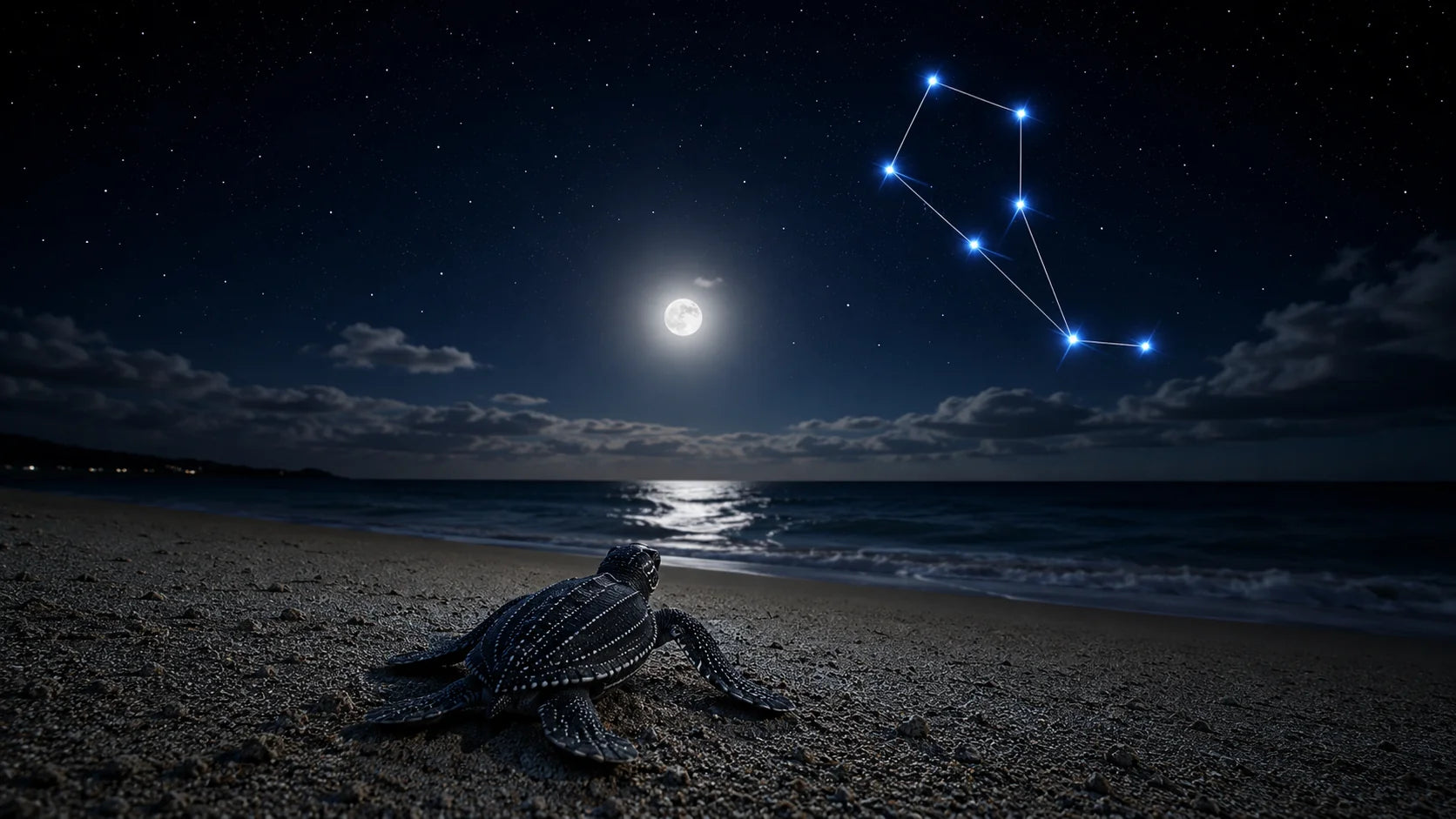
Artificial lights confuse the instincts of the hatchlings. On the beach, they make their way towards the brightest part of the sea horizon, guided by the light of the open sky, with the stars and the moon reflected on the water. The Florida Fish and Wildlife Conservation Commission (FWC) states that this behaviour occurs during all phases of the moon.
Field monitoring is changing the trajectory of a species.

Boötes belongs to the sky as a constellation, and to the ocean as the name given to a female leatherback turtle tracked by satellite, spotted at Juno Beach in Florida. The Loggerhead Marinelife Centre reports that she was first tagged on 20 May 2002, and has also been recorded by OCEARCH.
Several studies show that full-moon nights reduce navigational errors, whilst moonless nights increase the risk of disorientation, especially when artificial lights compete with natural light.
For the leatherback turtle, this point is even more interesting. A review by the Society for Integrative and Comparative Biology reports that, during a full moon, the leatherback hatchlings observed headed very accurately towards the ocean, whereas during a new moon they were more likely to go astray, sometimes swimming in circles. The moon therefore plays an important role for leatherback turtles as a light reference point.
At sea, nets, longlines, fishing lines and abandoned gear pose a major threat. A turtle caught in fishing gear can injure itself, become exhausted or drown. Collisions with boats also affect the turtles when they come up to the surface to breathe.
Pollution poses a constant risk. The leatherback turtle feeds mainly on jellyfish. Plastic bags, balloons, soft debris and certain types of floating rubbish can be mistaken for its prey. Ingesting these items can cause injury, blockages or death.
Climate change is also altering nesting conditions. The temperature of the sand influences the sex of hatchlings in sea turtles. Higher temperatures can skew the sex ratio of hatchlings, reduce egg viability or alter beaches through erosion, rising sea levels and storms.
Each threat affects a specific stage of their life cycle. Together, they place a strain on the entire species.
Conservation organisations are changing the fate of the nests and beaches.

The protection of sea turtles relies on patient and constant work on the ground.
Conservation organisations monitor nesting beaches, record tracks, protect nests, assist with hatchlings emerging from their nests, track females, collect data and raise awareness amongst local communities. They also work with fishermen to reduce bycatch, improve fishing practices and free turtles caught in nets wherever possible.
This work requires consistency. It involves night-time patrols, education, dialogue, scientific surveys and a sustained presence in sensitive areas.
The Te Mana o te Moana association operates precisely along these lines. It works on the protection and study of sea turtles, carrying out annual scientific monitoring of nesting on the Tetiaora atoll in French Polynesia. Their work brings together science, conservation and local communities through education.

This kind of commitment truly changes the trajectory of a species. A protected nest offers one more chance; a female that is saved means one more nesting season; and a monitored beach becomes a safe habitat.
Honu is committed to a clear sense of responsibility.
Honu Handmade Jewellery is committed to working with Te Mana o te Moana to support the protection of sea turtles and their habitats.
This commitment stems from the brand’s name, its symbol, my personal connection to the Congo, and the place the leatherback turtle holds within the Honu Handmade Jewellery identity.
It also stems from a simple conviction: beauty inspired by living things must play a part in their protection.
Honu Handmade Jewellery donates 1 per cent of its sales from all its jewellery to Te mana o te moana, and 5 per cent from pieces in the Kalunga capsule collection when it is launched to coincide with events such as World Sea Turtle Day on 16 June each year.
16 June 2027 will mark the convergence of three worlds: craftsmanship, jewellery and marine sustainability.
This gesture places each creation within a broader context. A piece of Honu jewellery remains a creation of material, craftsmanship and time, but it also draws attention to its source of inspiration.
The leatherback turtle provides the inspiration. Its conservation gives it meaning.
Preserving the leatherback and its sisters is tantamount to protecting an entire world.
The leatherback turtle is at the centre of this page, but its story is intertwined with that of all sea turtles.
Protecting it also means protecting the beaches, nests, nesting sites, migration routes, coastal waters, marine ecosystems and the human communities living nearby.
The sea turtle acts as a witness.
It reveals the state of the ocean, the quality of the beaches, fishing pressure, the presence of waste and the fragility of ecological balances. Its fate tells us something far greater than the story of its species alone.
Fighting for the leatherback turtle means preserving several species and choosing a relationship with the world that is mindful, practical and responsible.
The leatherback turtle moves silently, crosses the oceans, returns to the beaches, entrusts its lineage to the sand, then resumes its journey. It invites us to create with an active slowness, to choose natural materials and to link beauty to genuine responsibility.
Isabelle Bénatouil
Jewellery Artist

Pay in 3
3 interest-free instalments with Klarna, subject to eligibility