

Article: How to recognize genuine Tahitian pearls?
How to recognize genuine Tahitian pearls?
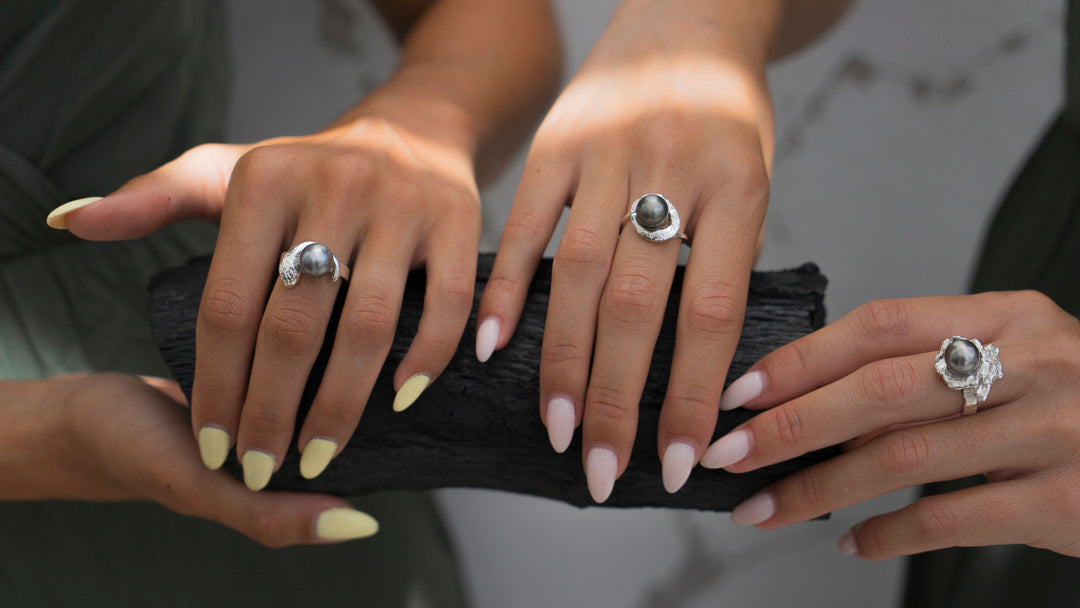
To recognise a Tahitian pearl, observe its lustre, shades, surface, weight, and temperature. A cultured pearl often shows deep reflections and slight natural surface irregularities. An imitation appears more uniform, smoother, and less alive in the light.
A true treasure cultivated in Polynesian oysters (Pinctada Margaritifera), Tahitian pearls are renowned for their rarity, prestige, and incomparable beauty.
Knowing how to distinguish genuine Tahitian pearls is essential for making a wise and confident investment.

Pinctada Margaritifera
As a genuine pearl ("Poe Rava" in Polynesian) is created by a living organism, it has its own DNA. It is therefore unique and there is no other like it.
Why do we speak of a "living pearl"?
Technical note: the Tahitian pearl is not a living organism in the strict biological sense (it has no active metabolism once formed). However, it is described as "living" in traditional jewellery vocabulary because its organic matter remains reactive: it evolves with its environment, it is nourished by contact with the skin, which rehydrates its matrix, and it can permanently lose its lustre if not worn and cared for. Jewellers even speak of a "dead" pearl when its lustre has faded irreversibly.
This terminology is established by Tahitian pearl farmers, by the great international jewellery houses (Mikimoto, Tasaki, Wan Pearls), and recognised by the reference bodies GIA (Gemological Institute of America) and CIBJO (World Jewellery Confederation), which classify pearls as organic gems as opposed to mineral gems.
Due to their rarity and high value, some imitation products are sold on the market. These fake pearls (usually made of ceramic, glass, plastic, or composites), artificially dyed and varnished, are perfect decoys for our eyes.
Criteria for recognizing a genuine Tahitian pearl
Its name
It must be clear and precise: "Tahitian Pearl," "Genuine Tahitian Pearl," or "Black Pearl of Tahiti."
Its density, weight, and temperature
A real pearl will always be denser, heavier, and colder than a fake one. By placing the pearl in the palm of your hand, you can evaluate these three criteria. Please note: a glass pearl will also pass this test.
Its luster and orient
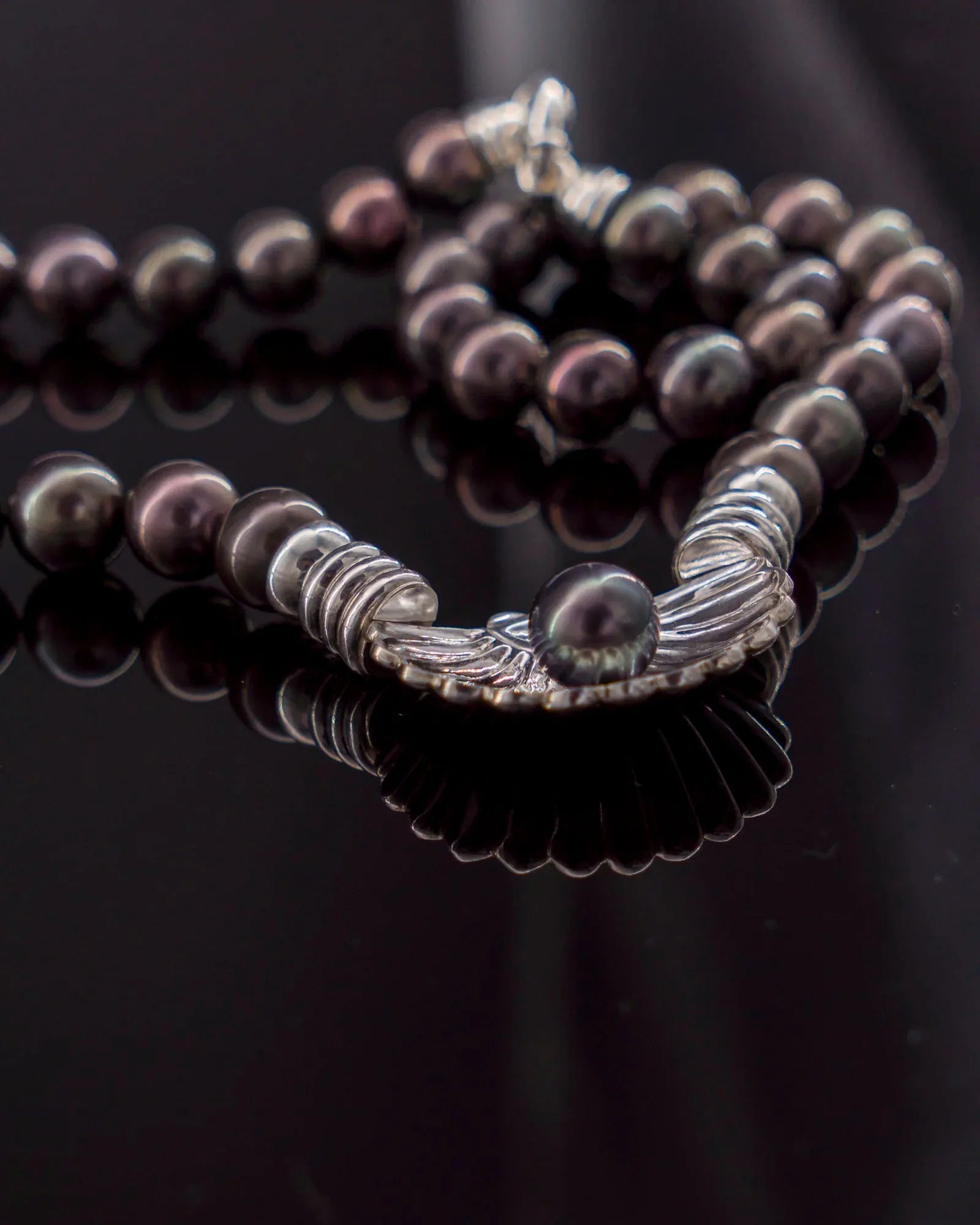
Like a mirror, its surface should perfectly reflect light (its brilliance). Like a prism, its orient allows it to display different colors depending on the light passing through it.
Orient is the reflection of light through the different layers of nacre (aragonite crystals). The finer and more numerous the layers, the more orient the pearl will have.
Nature offers a wide range of colors: dark gray, silver, intense green, peacock green, aubergine, pink, dark blue, light blue, champagne, or intense yellow. Whatever its color, it must vary depending on the light.

Its shape
There are various shapes: ringed, baroque, drop, button, quasi-round, round. A pearl categorized as "round" will never be perfectly round (nature is never perfect).
If your pearl is round, measure it with a caliper. If its measurements indicate a perfect sphere, its authenticity is questionable.
The tooth test
The thick mother-of-pearl composition guarantees the authenticity, quality, and durability of the pearl. Gently rub the pearl against the enamel of your tooth:
- Rough material = real pearl
- Smooth and slippery material = fake pearl
The foolproof method is to consult a professional equipped with microscopes, X-rays, and refractometers.
Our authentic Tahitian pearls

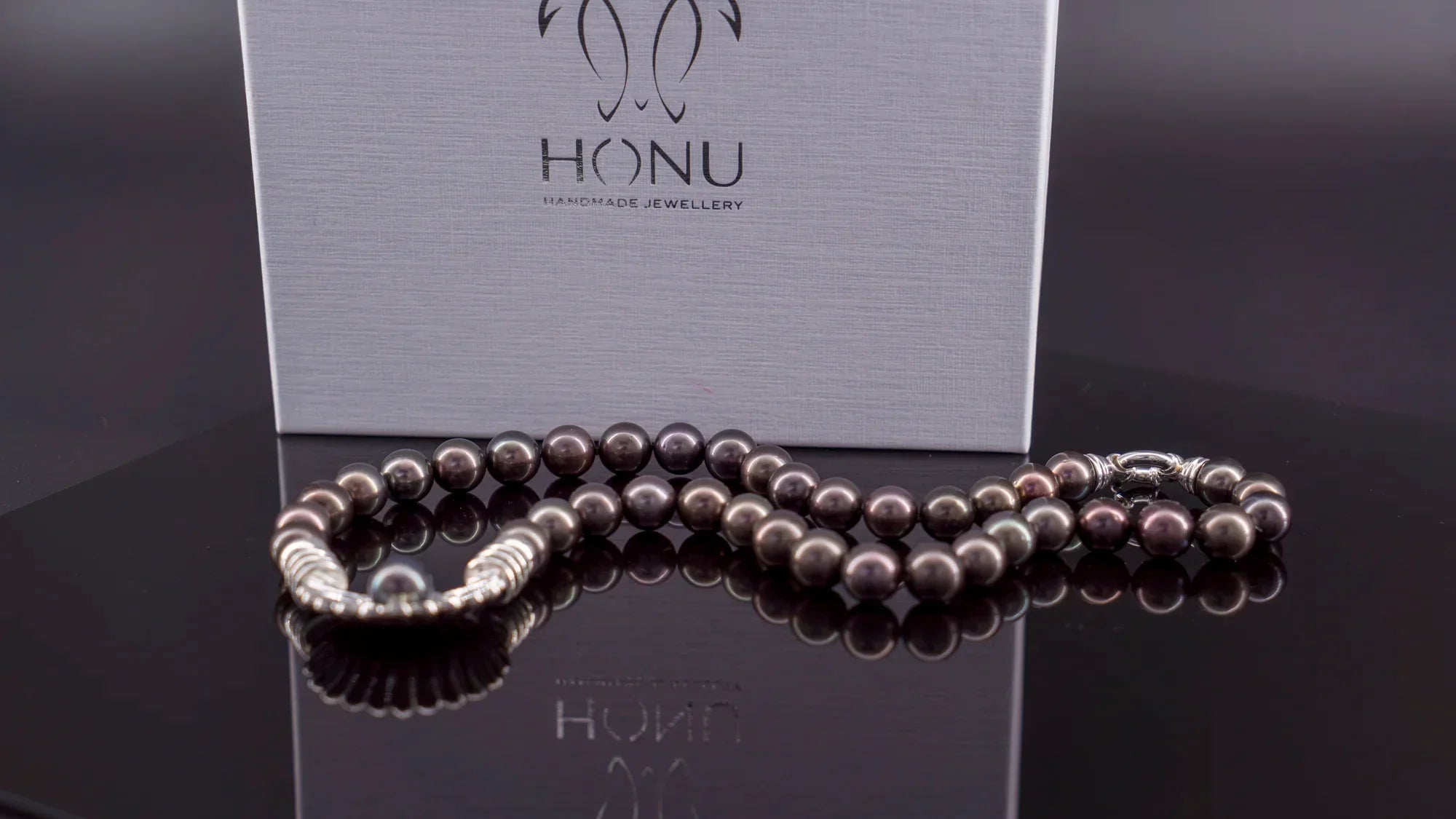
At Honu, each pearl is carefully selected and comes directly from an approved Polynesian pearl farm. I always provide a Traceability Booklet for complete transparency.
Going further with the expert guide

What you have just read is only an introduction. I have created a complete expert guide, a 24-page document gathering everything you need to know to recognise a Tahitian pearl: in-depth quality criteria, official classifications, natural colours, Polynesian legends, market pitfalls to avoid, care advice. A free document, available for download.

,%20Tahitian%20pearls%20are%20renowned%20for%20their%20rarity,%20prestige,%20and%20incomparable%20beauty.%0AKnowing%20how%20to%20distinguish%20genuine%20Tahit...)