Article: The drawer jewel syndrome: what to do with an inheritance you don't dare wear?
The drawer jewel syndrome: what to do with an inheritance you don't dare wear?
An inherited jewel that is never worn is not necessarily a forgotten object. It may carry too much memory to find its place. This article examines the possible options, keeping, passing on, selling, recycling, or transforming, while considering attachment, material, and tax context.
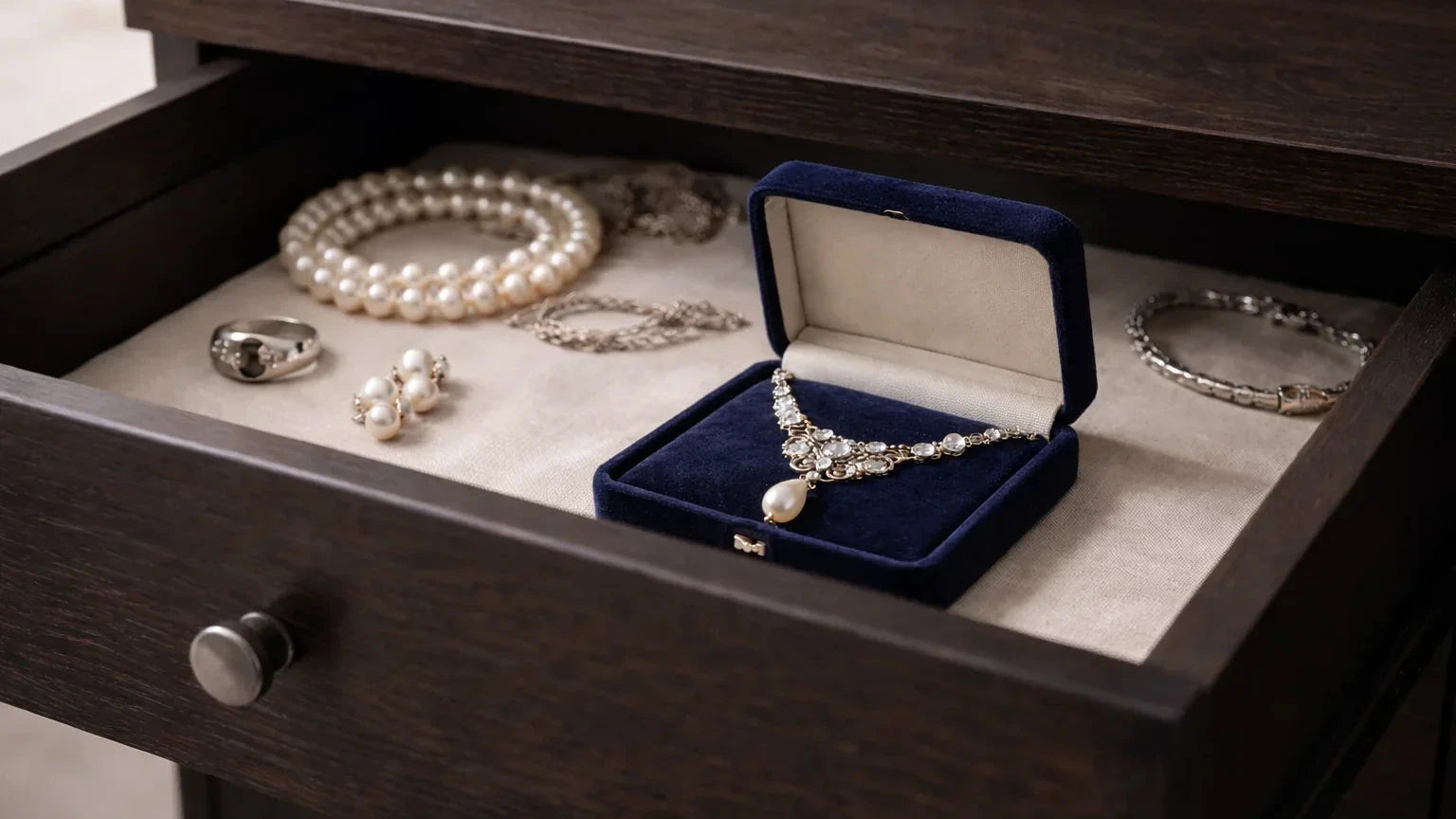
It’s been there for years, in its velvet case, at the back of the drawer, and we never wear it. We’ll never sell it; we don’t know what to do with it, and every time the drawer opens, it stares back at us.
This piece of jewellery is a grandmother’s ring, a pearl necklace received upon the reading of a will, or a brooch that no one dared to claim. It is steeped in emotion, weighed down by memories, and yet it remains invisible.
According to a survey by the jewellery industry, about two-thirds of inherited jewellery is never worn. These pieces, which have accompanied entire lives, end up sleeping in the dark, between an expired passport and a box of cufflinks.
The "jewellery-in-the-drawer" syndrome is an excess of attachment that cannot find its form.
The heir’s guilt
An inherited piece of jewellery functions as a concentrated memory materialized in a few grams of metal and ornamentation. It carries within it the presence of a departed person, a fragment of their daily life, and also the imprint of their wrist or neck.
Psychologists have a name for this phenomenon: magical contagion, a concept established by Paul Rozin and his colleagues in the Journal of Personality and Social Psychology in 1986. Their research, since confirmed by dozens of studies in consumer psychology, shows that we spontaneously attribute to an object the invisible properties of the person who wore it. The piece of jewellery that has touched the skin of a loved one retains, in our perception, something of that person. Taking it out of its case is almost like summoning them. Leaving it at the bottom of a drawer is keeping them at a distance without losing them entirely.
And that is where the double guilt sets in.
First guilt: not wearing the jewellery. We feel as though we are betraying the memory of the person who passed it on to us. As if not wearing it amounts to downplaying its importance, to relegating the memory to the status of an outdated accessory.
Second guilt, even more subtle: the idea of altering it. Changing its form is “destroying” the memory and erasing the physical trace of the loved one, and many dare not even voice this thought.
The problem is rarely the monetary value. It is the disconnect between the object as it is and the person we have become. The ring is too flashy, the pendant is too dated, and the bracelet doesn’t go with anything we wear. We then find ourselves the guardians of a legacy that we deeply respect, but that we cannot integrate into our lives. That is why the jewellery remains locked away in a drawer.
What the law says, and what the tax authorities say
In France, all jewellery received as an inheritance must be declared as part of the estate’s assets. Article 764 of the General Tax Code provides specific guidelines for this valuation, and two categories must be distinguished:
- Furniture (tables, chairs, cabinets, etc.): in the absence of a notarized inventory or public sale, a flat rate of 5% of the estate’s assets applies (Article 764-I CGI).
- jewellery, precious stones, works of art, and collectibles : the 5% flat rate does not apply . Article 764-II of the General Tax Code provides for a specific regime. The declared value cannot be lower than that stated in a valid insurance policy against theft or fire in effect on the date of death and taken out less than ten years prior, unless proven otherwise. In the absence of insurance, the value used is that of a public auction or a detailed inventory conducted by an auctioneer, a notary, or a bailiff.
This is an important distinction: many heirs believe they qualify for the 5% flat rate on their jewellery, which is factually incorrect.
In the event of the resale of inherited jewellery, two tax regimes are available, at the seller’s discretion:
- The flat-rate tax on precious objects (TFOP) : 6% of the sale price, plus the CRDS at 0.5%, for a total of 6.5% for jewellery, works of art, collectibles, or antiques (Articles 150 VI to 150 VM of the General Tax Code). Note: Sales of jewellery priced at €5,000 or less are exempt from this tax. Please note: If the jewellery is melted down and resold as precious metal (ingots, scrap), the rate increases to 11.5% (11% + 0.5% CRDS), applicable from the first euro.
- Capital gains tax on movable property : 19% income tax, plus social security contributions. Since the Social Security Financing Act for 2026 took effect, the social security contribution rate on capital gains has increased from 17.2% to 18.6% , bringing the overall rate to 37.6% on the realized capital gain. This regime offers a 5% tax deduction per year of ownership beyond the second year, leading to a total exemption after 22 years of ownership (Articles 150 UA and 150 VC of the General Tax Code).
One point deserves attention for those considering remodeling rather than resale: having an inherited piece of jewellery remelted or remodeled causes it to lose its provenance value, that symbolic added value linked to its history, original signature, or the age of the hallmark. On the other hand, the intrinsic value of the metal and stones is fully preserved.
One final step to take: after receiving an inheritance or having jewellery altered, it is essential to update your home insurance policy, as the declared value of the jewellery determines the maximum compensation amount in the event of a claim.
The material never dies
Here’s a fact few people know: solid silver, like gold, can be recycled infinitely without any loss of quality. It’s pure chemistry.
When a silver piece of jewellery is melted down and refined, the atoms that make it up remain exactly the same. The recycled silver from a 1950s ring is, at the molecular level, indistinguishable from silver freshly extracted from a mine. The form disappears, but the material remains. There is no degradation, no "fatigue" of the metal, and no loss of purity.

This remarkable property makes precious metals unique in the world of materials. Unlike plastic, paper, or even certain industrial alloys, silver and gold do not degrade over the course of processing cycles.
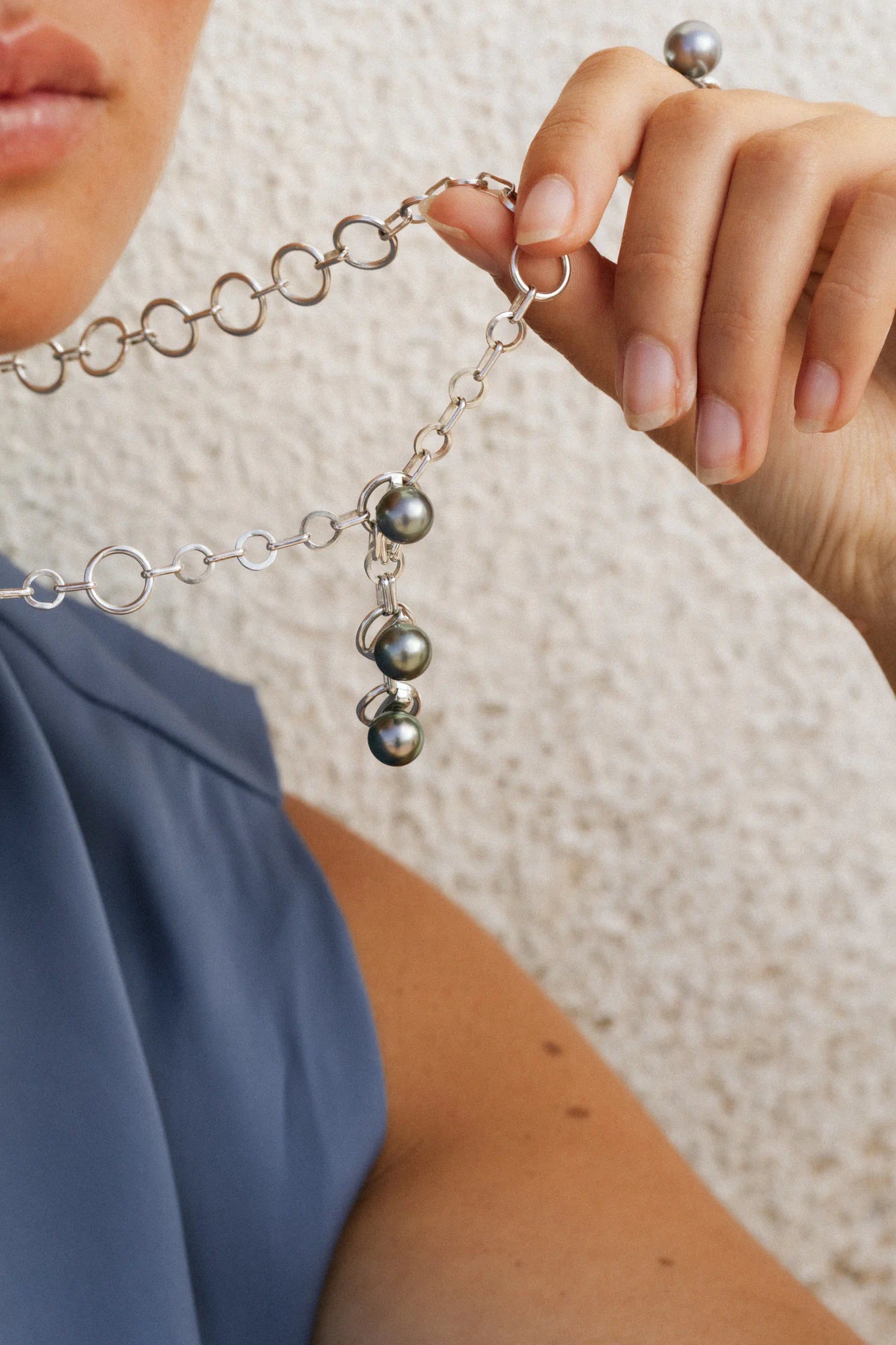
The environmental impact speaks for itself. According to comparative data published by several stakeholders in the responsible jewellery industry, recycling silver generates about one-seventh of the CO₂ emissions produced by mined silver, a reduction of approximately 85%. For gold, the difference is even more dramatic: approximately 1,100 kg of CO₂ equivalent per kilogram of recycled gold, compared to 16,000 kg per kilogram of mined gold, a reduction of about 93%. Choosing to transform an existing piece of jewellery (such as the Victoria Necklace, designed to accommodate your own pearls) rather than creating something from new metal is a concrete ecological gesture.
The material of your heirloom is literally eternal. Only the form is temporary.
Transforming is not betraying
In Japan, the art of kintsugi involves repairing broken ceramics with lacquer mixed with gold powder. Far from hiding the cracks, this technique highlights them. The repaired object does not pretend to be new. It displays its history, its golden scars, and through this transformation acquires a beauty that the intact object did not possess.

This philosophy applies with particular aptness to heirloom jewellery. To transform is not to destroy, but to continue. It is to allow the material to continue its journey in a form that corresponds to the life of the person wearing it today.
The history of a piece of jewellery lives within the material itself, within those atoms of silver or gold that have spanned the decades. A grandmother’s ring recast into a contemporary pendant does not lose its history but, on the contrary, gains a second one.
Academic research in consumer psychology confirms this intuition. In his seminal article “Possessions and the Extended Self” (Journal of Consumer Research, 1988), Russell Belk demonstrates that an object’s emotional value is not fixed in its original form: it is renewed and amplified when the object is actively integrated into its owner’s life, unlike an object set aside, which sees its emotional bond erode over time.
This awareness is gradually taking hold in France. More and more jewellers are offering to redesign and transform family heirlooms, responding to a demand that goes far beyond a mere trend. It represents a shift in perspective regarding inheritance: moving from static preservation to living transmission.
The transformed piece of jewellery carries two stories: that of the person who wore it before, and that of the person who wears it now. It sheds its status as a “relic behind glass” to become a bridge between generations.
And what about your jewellery in the drawer?
Perhaps as you read these lines, you’re thinking of a specific piece of jewellery. The one that has lain dormant in the darkness since the passing of someone you loved. The one you’ve never dared to wear, let alone transform.
What’s holding you back may not be guilt or market value. It may be something older, something deeper: that silent conviction that as long as the piece remains intact, something of the person who wore it continues to exist. A form of private superstition we don’t admit to, but which weighs more heavily than any rational consideration.
So ask yourself this one question: would you rather have a piece of jewellery that keeps a memory hidden away, or one that brings it into the open, against your skin, into your life?
The answer is yours.