

Article: Fire stains: the jeweller's silent nightmare
Fire stains: the jeweller's silent nightmare
Firestain appears as purplish shadows within solid silver after heating. It comes from the oxidation of copper present in the alloy and forms beneath the metal surface. Preventing it requires heat control, metal protection, and patient polishing.
The piece lies there, in front of me, on the workbench. I’ve just spent hours brazing, shaping, and inspecting it. The silver gleams, its surface is smooth, and its curve is just right. I pick up the polishing tool for the final pass (the ultimate revelation), and it is precisely there, beneath the mirror-like surface of the metal, that I see them appear.
Diffuse, purplish shadows, like bruises beneath skin that’s too thin.
These are the fire marks. They aren’t on the surface; they’re underneath, in the flesh of the metal. Impossible to wipe away and, above all, impossible to ignore.
It is the silent nightmare of every silversmith who works with a torch to process silver.
It is a phenomenon that the customer will never (or rarely) see and that most people are unaware of, but which haunts every time the silver is held to the flame. Paradoxically, it tells the story better than any speech of what it truly means to work with a precious metal.
What Happens Beneath the Surface
To understand fire spots, we must go back to what solid silver really is. Pure silver, at 999 parts per thousand, is too soft for Jewellery. Copper is therefore added to strengthen it: 7.5% in 925 (sterling), 5% in 950, which I use primarily. It is this copper, though essential, that poses a problem.
Above 537 °C, oxygen from the air penetrates the alloy and binds with the copper to form cupric oxide (Cu₂O), a dark purple compound that lodges between the metal grains. It is important to distinguish between two phenomena that are often confused: firescale and firestain. Firescale, on the other hand, remains on the surface. It is a layer of oxides that can be dissolved in an acid bath (standard pickling after brazing or a quick pass over a flame). Fire stains, on the other hand (i.e., firestain), are a problem of an entirely different nature. The oxide forms deep within the metal, beneath the surface, where no acid can reach. It is a permanent oxide.

And here’s what makes it particularly frustrating: 950, despite containing only 5% copper, is not spared. Oxygen diffuses so quickly into the alloy that the copper cannot escape it. Even this reduced proportion of copper is enough to trigger the phenomenon. Artisans working with 960 report having eliminated the problem, but with 950, it persists. Pure gold, on the other hand, does not have this problem, simply because it contains no reactive copper in its traditional alloys (Peter Johns, Santa Fe Symposium, 1997).
Each pass with the torch makes things worse
What makes fire spots so insidious is their cumulative nature. Each pass with the torch drives oxygen a little deeper into the metal. The first annealing creates a thin layer. The second brazing thickens it. The third makes it nearly impossible to remove without removing a significant amount of material.
Working temperatures leave no margin for error. Silver anneals at around 593 °C. Soft braze (which I use very little, if at all) melts at around 620 °C. Hard braze reaches 750 °C. All of these temperatures far exceed the critical threshold of 537 °C (Ganoksin jewellery Making Community). In other words, every heat treatment is an invitation for oxygen.
Complex pieces, those requiring three, four, or sometimes five successive brazing operations, are the most vulnerable. The more ambitious the design, the higher the risk of these purplish or grayish shadows appearing during the final polishing. It is a cruel irony: the piece in which one invests the most time and technical skill is the one most likely to reveal this invisible flaw.
The jeweler’s weapons against fire stains
Faced with this phenomenon, the jeweler has several strategies at their disposal, none of which is perfect.
The protective flux, made from borax, creates a glassy barrier on the metal during heating. This transparent film prevents oxygen from reaching the surface. It is the first line of defense, the oldest, and remains indispensable.
The charcoal block used as a brazing support creates a locally reducing atmosphere. As it burns, the charcoal produces carbon monoxide (CO), which consumes the ambient oxygen around the piece. A discreet but effective ally (Goldsmiths’ Centre, London).
Mastering the heating time is essential. A wide flame that heats up quickly, a confident hand that does not linger: every second saved is one less second for oxidation.
Argentium, developed by Peter Johns in 1997 and presented at the Santa Fe Symposium, incorporates 1-2% germanium into the alloy. This germanium migrates to the surface during heating and forms a transparent protective layer of germanium oxide. An elegant solution, but one that alters the metal’s working properties and is not suitable for all approaches.
Depletion gilding involves alternating cycles of heating and acid etching to deplete the surface of copper, creating a thin layer of nearly pure silver. The result is visually flawless, but the oxidized copper remains underneath, simply masked (Martin Ebbers, "The Chameleon Effect on solid silver," SNAG Metalsmith).
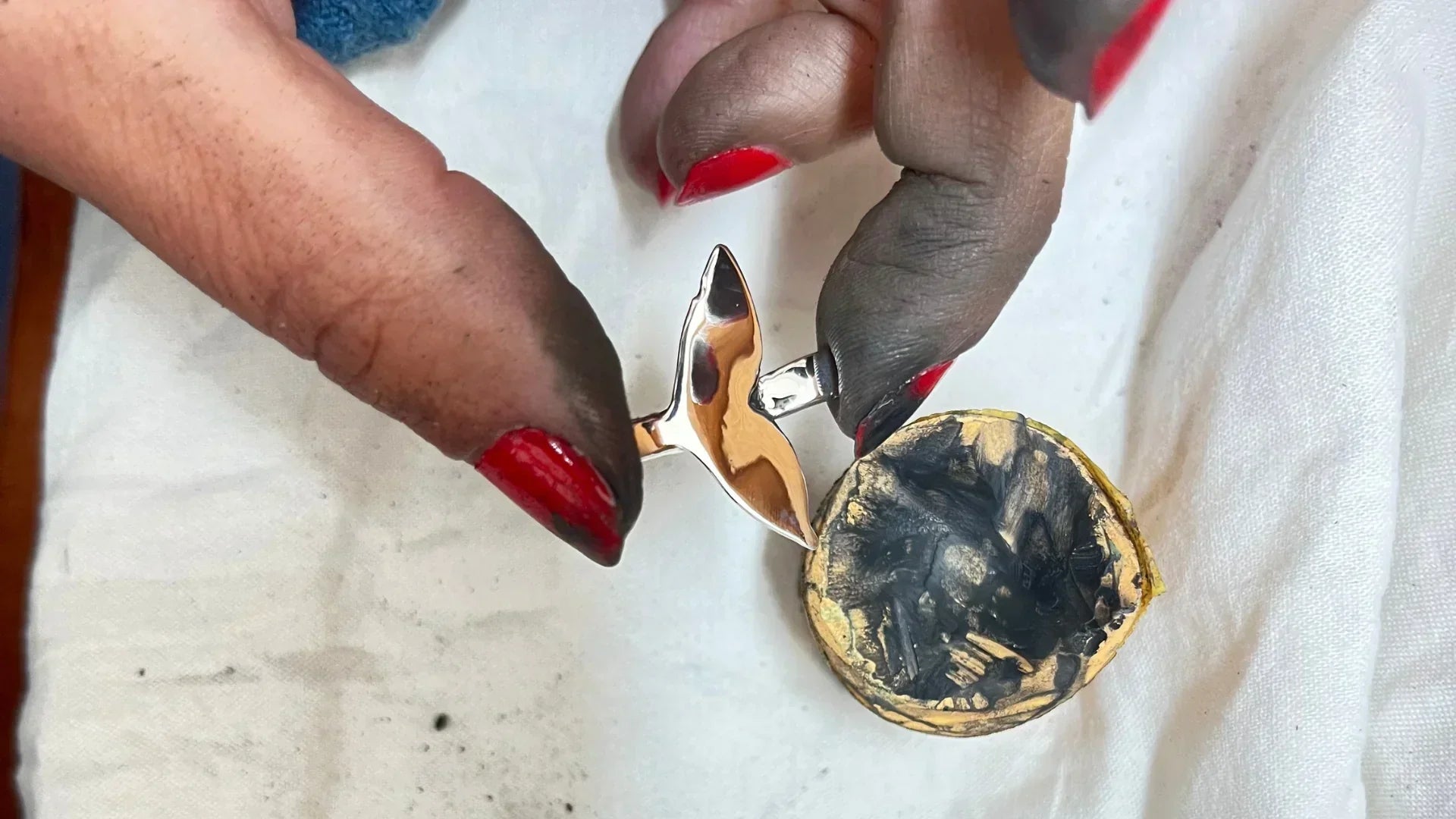
And then there is abrasive polishing, the only method that truly removes deep stains. The contaminated layer is mechanically removed, grain by grain. It is time-consuming, it is precise, and metal is sacrificed. But it is the only honest solution to the problem.
My Relationship with Fire Stains
I work primarily with 950 silver, a choice I make for its purity and whiteness. But working with 950 silver spares me nothing. Fire marks are part of my daily workshop routine, and they have taught me two things I would not have understood otherwise: patience and humility in the face of metal.
Prevention has become a ritual. Flux applied with care, a controlled flame, precise movements to minimize heat exposure. I know the limits of each braze; I know the moment the metal begins to reveal what lies beneath. And despite all these precautions, shadows sometimes appear during polishing. That is the moment when one must accept the need to start over, patiently and without frustration.
This is also what distinguishes handcrafted work from industrial production. This obsessive attention to detail, this hunt for the invisible, this determination to deliver a piece whose surface hides nothing. The machine does not know this struggle. It does not battle against oxygen at 600°C. The mirror-polished finishes of my Joséphine B. collection, with their unforgiving geometric shapes, are a direct test against fire marks. Each piece must be polished, inspected, and reworked, sometimes several times, until the surface hides nothing and becomes that surface that has passed through the flame and emerged from it, mastered.

Understanding metal to respect it
Fire marks remind us of a truth we easily forget when looking at a finished piece of jewellery: working with a precious metal means understanding it. It means knowing its reactions, anticipating its weaknesses, and respecting its limits. The final result, that luminous, pristine surface we admire, reveals nothing of the invisible struggle that preceded it. Yet it is there, in that space between the flame and the polishing tool, that the difference lies between an industrially manufactured object and a piece of jewellery truly born of the hand and craftsmanship.